
Part 1: When Healthcare Follows You Home
Maria is 67 years old. She lives alone and manages several chronic conditions - diabetes, mild heart disease, and arthritis. None of these illnesses define her, yet each requires attention. Her weeks are punctuated by appointments in different buildings: blood tests in one clinic, heart monitoring in another, primary care somewhere else. Each visit makes sense on its own. Each physician focuses carefully on a specific piece of her health. But Maria is the only one holding the full picture.
Over time, her blood sugar trends slightly upward. She feels more fatigued in the afternoons. Her ankles swell just a little. Nothing dramatic. Nothing urgent. These changes drift quietly across months until one winter evening she wakes up short of breath and frightened. By midnight she is in the emergency department, surrounded by machines, specialists, and the impressive machinery of modern rescue medicine.
Healthcare, as we have designed it, excels at this moment of crisis. We have built a system that mobilizes powerfully when deterioration becomes unmistakable. Yet this strength reveals an uncomfortable truth: we often wait too long.
For more than a century, healthcare has been organized around institutions. Hospitals, clinics, ministries, and administrative hierarchies form the visible architecture. When something goes wrong, the patient travels inward toward the system. Care lives inside walls. That structure once aligned well with the problems it was built to solve. Acute infections, traumatic injuries, surgical interventions - these were episodic events requiring concentrated expertise.
But the nature of illness has changed. Today, most health challenges unfold gradually across years. They are shaped by lifestyle, environment, aging, and complex interactions between multiple conditions. Health does not happen inside buildings; it unfolds in kitchens, workplaces, bedrooms, and quiet evenings at home. The institutional model remains powerful, yet it no longer fully matches lived reality.
Now imagine a different story for Maria. Instead of waiting for crisis, small changes are noticed early. Her wearable device detects subtle shifts in heart rhythm. A connected scale observes gradual fluid retention. Her glucose readings show patterns over weeks rather than isolated numbers at appointments. These signals do not trigger alarms or panic; they create awareness.
She receives a simple message explaining that her recent trends suggest a mild adjustment in medication might help. A brief virtual conversation with her care team confirms the plan. The swelling recedes. The fatigue improves. The emergency visit never happens.
In this scenario, hospitals remain essential, but they are no longer the gravitational center of care. They become specialized nodes within a broader, distributed network that surrounds daily life. Care feels less episodic and more continuous. It feels less like rescue and more like steady companionship.
Such a transformation is not merely technological. It is structural. It requires that information flow seamlessly across settings and that individuals understand what their data means. When people can see their health patterns clearly and participate meaningfully in decisions, they feel less like passengers and more like partners in their own trajectory. Physicians, in turn, gain earlier visibility into emerging risk, allowing for gentler corrections rather than dramatic interventions.
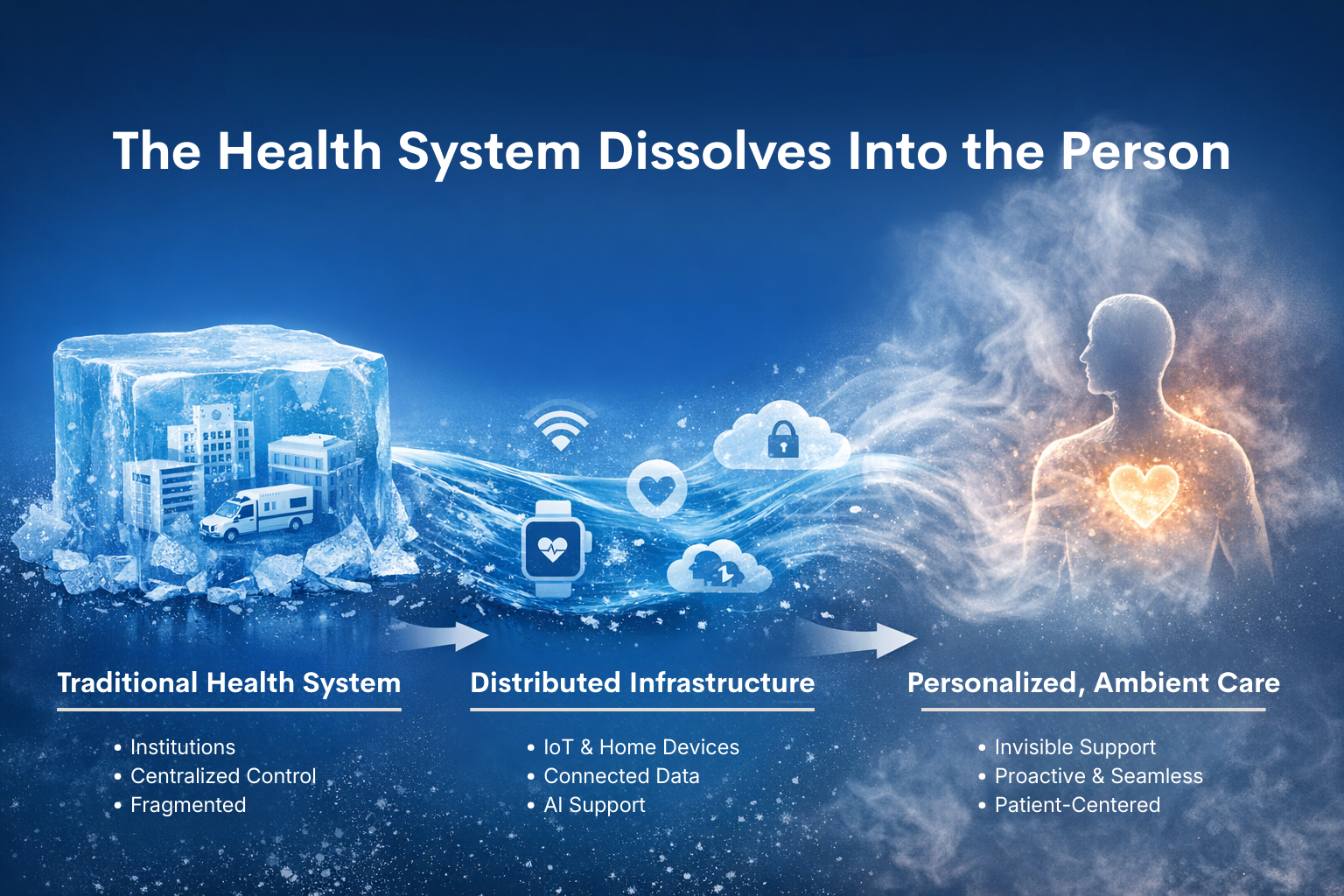
Around the world, health systems are under mounting strain. Aging populations, rising chronic disease, workforce shortages, and fiscal pressures expose the limits of an architecture built for another era. Adding more layers of control or more institutional capacity will not resolve a structural mismatch. What is needed is a reorientation: from buildings at the center to people at the center.
If patients truly matter most, the design must reflect that principle. Care should not begin at the hospital door; it should begin long before deterioration becomes visible. It should accompany individuals quietly, interpreting signals, connecting information, and supporting small course corrections. In such a system, intelligence distributes outward rather than concentrating inside institutions, and learning becomes continuous rather than episodic.
The future of healthcare may not look like a larger hospital or a faster emergency room. It may look like something subtler and more human: a system that walks beside people throughout ordinary life, helping them remain well rather than merely rescuing them when they fall ill. When healthcare follows us home, the system no longer feels like a distant structure we visit in moments of crisis. It becomes living infrastructure - present, responsive, and aligned with the rhythms of daily life.
